Blog
Where Meat Processors Lose Yield (and How to Find It)

Short answer: Meat plants lose yield at six predictable points: dressing on the kill floor, cooler shrink, fabrication and trim, further processing (cook, smoke, cure), packaging giveaway, and inventory shrink and spoilage. You find out where by weighing product in and out at each point, tying those weights to a lot, line and shift, and comparing actual yield to a standard every day instead of at month-end. Giveaway is usually the fastest loss to recover, because it is pure product given away for free.
Most processors know their overall yield. Far fewer know where it is lost, because the number is calculated from month-end inventory instead of captured at each step. A plant can hit its monthly yield target while one line, one shift or one product is quietly leaking margin every day.
Where is yield lost in a meat processing plant?
How do you calculate yield at each step?
- Dressing % = hot carcass weight ÷ liveweight × 100
- Cooler shrink % = (hot weight − cold weight) ÷ hot weight × 100
- Cutting yield % = output weight ofproduct(s) ÷ input carcass or primal weight × 100
- Batch yield % = finished batch weight ÷total input weight × 100
- Giveaway %= (actual net weight − declared net weight) ÷ declared net weight × 100
Every formula needs two weights tied to the same lot or batch. If you only weigh at the end, you can calculate total yield but cannot see which step lost it.
How do you know where yield is being lost?
- Set a standard for each step (by species, product, spec and customer) based on your best sustained performance.
- Capture weights in and out at the scale, linked to lot, batch, line, shift and, where appropriate, operator. Hand-written weights are too slow and too forgiving to diagnose loss.
- Compare actual to standard daily.Month-end yield hides problems for weeks.
- Slice the variance. Look for patterns by line, shift, supplier, animal grade or product. Losses that only appear on one shift are training or setup problems; losses that follow a supplier are raw material problems.
- Fix one leak, then re-measure.
What is giveaway and why does it matter so much?
Giveaway is product you ship above the declared or invoiced weight. In fixed-weight packaging, a 1 lb pack that actually weighs 1.03 lb gives away 3% of the product for free. In catch-weight cases, giveaway shows up when tare weights are wrong or weights are rounded down. Because it is finished, saleable product, every recovered pound is pure margin.
Worked example (hypothetical, for illustration)
Aprocessor packs 300,000 lb of product per week at an average selling price of$3.50/lb, with average overpack of 1.5%.
- Reducing overpack from 1.5% to 1.0% recovers 0.5% of volume.
- 300,000lb × 52 weeks × 0.5% = 78,000 lb per year.
- 78,000lb × $3.50 = about $273,000 per year in product no longer given away.
- Your numbers will differ. The point is structural: at current meat prices, half a percent of give
Your numbers will differ. The point is structural: at current meat prices, half a percent of giveaway can pay for an entire plant-floor system. If you don't know your giveaway rate today, measuring it is the first finding. (See the full ROI model in our meat processing software cost and ROI guide.)
How do you reduce giveaway?
- Weigh every package or case on a certified,calibrated scale connected to the labeling system.
- Managetare weights centrally per product and packaging, not per scale.
- Set target weights from actual scale variation,not habit.
- Report giveaway by product, line and shift every day.
- Use catch-weight labeling where customers acceptit, so you bill actual weight.
What data should a meat processor collect on the plant floor?
How does yield tracking software work?
Yield tracking software connects directly to scales on the kill floor, cut floor, production lines and packaging stations. Each weighment is recorded with its lot, batch and product automatically, so the system can calculate yield for any animal, lot, batch, line or shift on demand and compare it to standard. Because the same data also drives labels and inventory, yield, traceability and inventory accuracy improve together rather than as separate projects.
How much can better yield tracking save?
It depends on volume, price and how much loss is currently invisible, but the savings usually come from four places: giveaway reduction, catching cutting and trim problems within a shift instead of a month, lower inventory shrink and expiry, and fewer labor hours spent recording and reconciling weights by hand. Because meat is the largest cost in the plant, small percentage gains in yield typically outweigh labor savings.
How Carlisle Technology helps processors find and recover yield
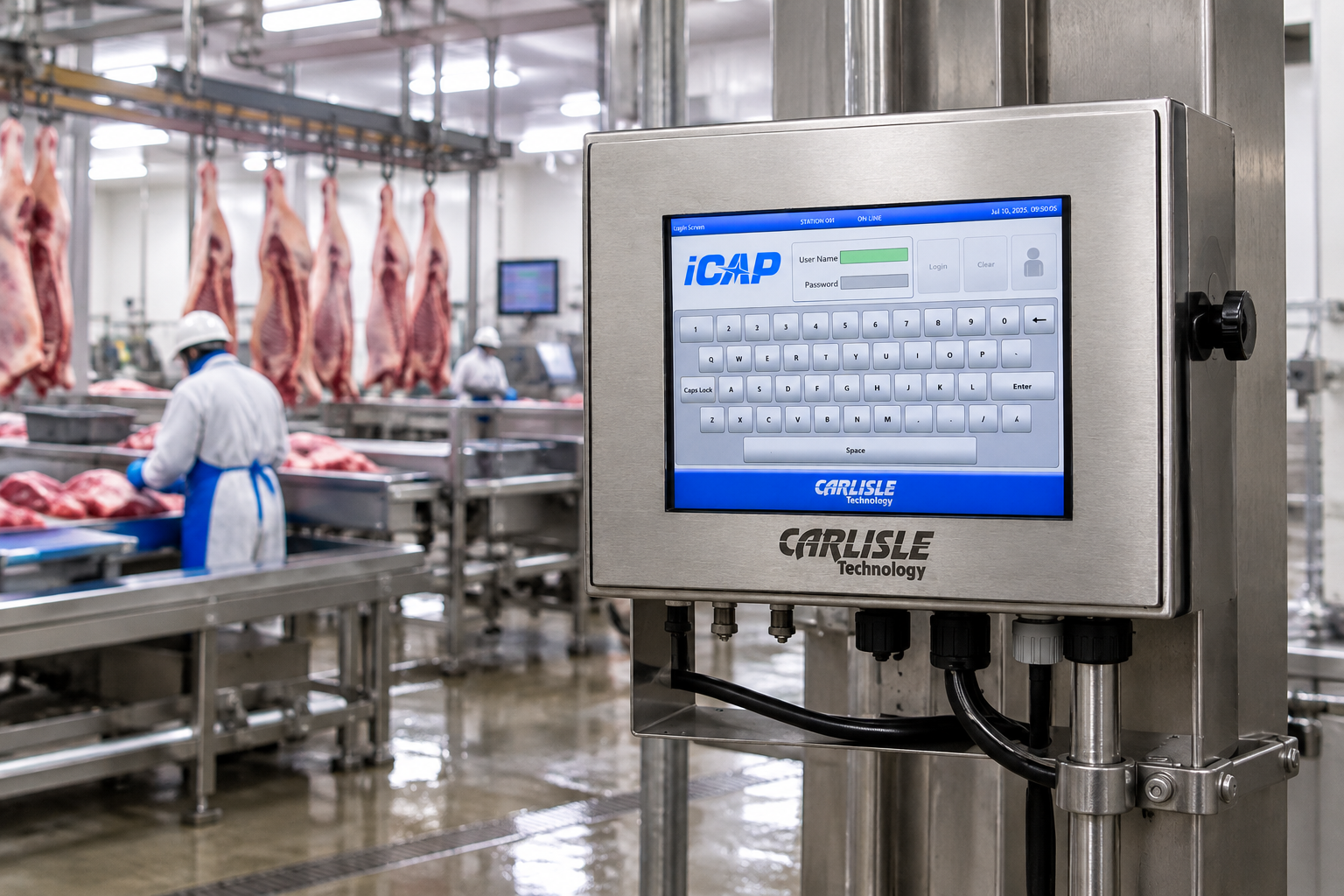
Carlisle Technology has built weighing, labeling and plant-floor software for meat processors since 1985. iCap integrates scales, printers and scanners into weighing and labeling stations from the kill floor through case packing, and Symphony records carcass weights, grades and yields on the kill floor, links raw material inputs to production batches, and reports lot and batch yield and product giveaway. Because Carlisle supplies the scales and plant-floor computers as well as the software, weights flow directly into yield reports without manual entry.
Request a yield and giveaway assessment
Frequently asked questions
What is a good yield for a meat processing plant?
There is no single number. Yield depends on species, grade, cutting specification and product mix. The useful benchmark is your own best sustained performance for each product and step, tracked daily.
Whatis the difference between yield loss and shrink?
Yield loss is weight lost through processing steps such as dressing, chilling, trimming or cooking. Shrink usually refers to inventory lost after production through damage, expiry, mispicks or untracked rework.
How do beef processors track carcass yield?
By recording live weight, hot carcass weight, cold weight and fabricated outputs against each carcass or lot, usually linked through ear tags, RFID or carcass tags, then comparing actual to expected yields by grade.
How do pork processors track carcass yield?
Similarly, typically using tattoo numbers or lot IDs at receiving, trolley or RFID tracking through the kill, hot weights at the scale, and cut-out yields from fabrication linked back to the lot.
How do further processors calculate batch yield?
By weighing every input issued into a batch (meat, brine, ingredients) and every output out of it, then dividing output by input. Tracking this per batch shows which recipes, ovens or shifts lose the most.
Can spreadsheets track yield well enough?
They can show totals, but they depend on hand-recorded weights and rarely link weights to lots, lines and shifts in real time, which is what you need to find where loss happens.
What is the fastest way to start?
Measure giveaway at packaging for two weeks with connected scales. It is usually the largest, fastest-to-fix leak, and the result builds the case for tracking yield upstream.
Previous Blog Post
Next Blog Post

Let's talk.
Get in touch with our team to find the right solution for your processing plant.
