Blog
Step-by-Step Guide to Meat Product Traceability (Using Carlisle Technology)
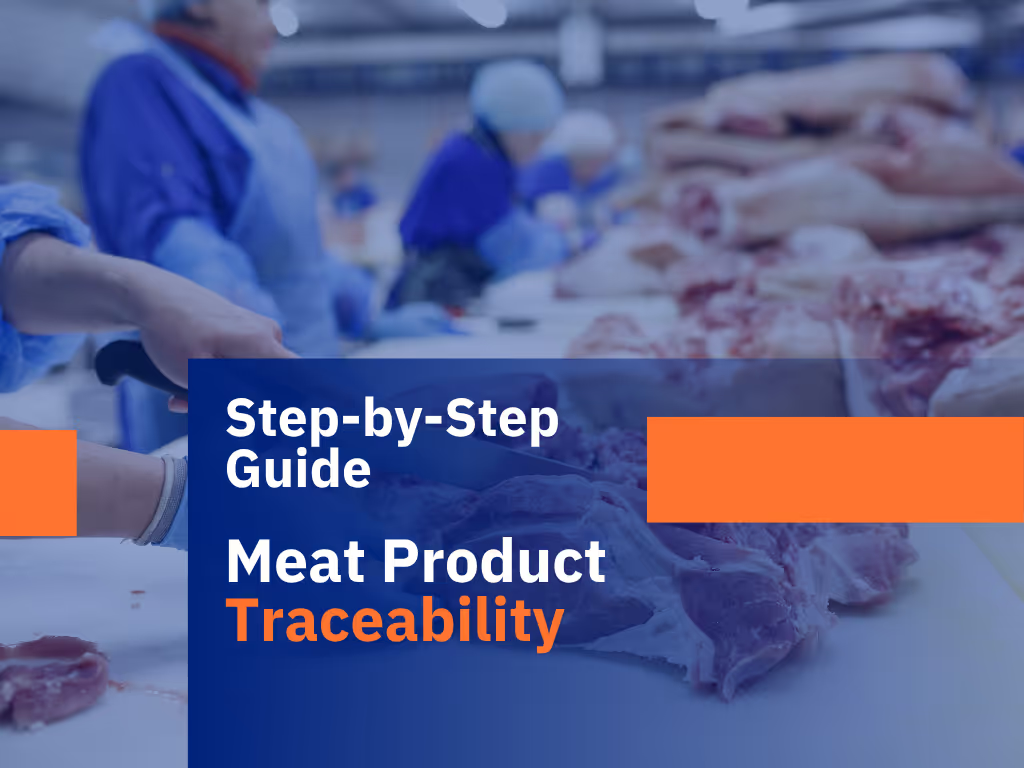
Updated: September 14, 2025. Built for beef, pork, and poultry processors across the U.S. & Canada.
TL;DR
- Why it matters: Robust, verifiable trace-back reduces recall scope, audit friction, and brand risk. CFIA defines traceability as tracking a food “one step back and one step forward.”
- What you’ll implement: A plant-floor-to-finished-goods workflow capturing live/hot/cold weights, ear-tag retirement (beef), tattoo-to-carcass association (pork), RFID/trolley tracking, grading, and lot yield reporting, mapped to unique IDs and GS1 best practices.
- Business impact: Direct recall costs are often cited around ~$10M on average, before legal fees and reputational damage.
References: https://www.foodmanufacturing.com/safety/article/21123459/reducing-the-risk-of-recalls , https://www.fooddive.com/news/more-than-money-what-a-recall-truly-costs/426855/ - How to start: Follow the 8 steps below. When ready, connect everything end-to-end with Symphony Meat Processing Software to cut trace times from hours to minutes.
Who this guide is for
Primary processors (beef, pork, poultry, mixed), provincially or federally inspected establishments, and custom-kill operations seeking audit-ready traceability aligned to CFIA/SFCR, USDA/FSIS oversight, and GS1 identification/records practices.
- CFIA/SFCR: https://inspection.canada.ca/en/food-safety-industry/traceability
- USDA/FSIS: https://www.fsis.usda.gov/
- Global Traceability Standard using GS1: https://www.gs1.org/standards/gs1-global-traceability-standard/current-standard
What meat traceability outcomes to target
- Unique identification from receiving through harvest and into finished goods, no dead ends.
- Linked weights and attributes at every control point (live - hot - cold) for yields, grading, and settlement.
- Clear, auditable lots (standard vs. custom-kill, HACCP receiving questions answered, fees applied where needed).
- Automated movement tracking (e.g., trolley/RFID on pork) with optional cooler sortation.
- Unique GS1-aligned identifiers/events (e.g., GTIN + lot/batch; EPC/RFID) for partner interoperability.
The 8-Step Implementation Plan (Using Symphony)
Below shows where to capture data, what to capture, and how Symphony operationalizes it with plant-floor data collection (iCap), scales, scanners, RFID/trolley tracking, and reporting.
Step 1: Define your ID strategy & master data (GS1-aligned)
- Assign unique carcass IDs, lot IDs, and finished-goods identifiers (GTIN + lot/batch).
- Determine when/where to retire animal IDs (ear tags) and how to map tattoo numbers (pork) to carcass records.
- Document the events you’ll record (receive, transform, pack, ship) per GS1 guidance.
GS1: https://www.gs1.org/standards/gs1-global-traceability-standard/current-standard
Step 2: Live Animal Receiving (office or floor)
- Create a receiving lot (supplier/customer, transport details).
- Set standard vs. custom-kill, apply configurable custom-kill fees, answer HACCP receiving questions.
- Capture lot weight and print a lot tag for downstream tracking.
Step 3: Beef kill floor: identify & weigh
- Capture live (or near-live) weight with animal ear tag; print carcass tag to follow the carcass.
- At the hot scale, scan the carcass tag and record hot weight; print a hot-scale tag.
- Optionally capture cold weight when pulling from cooler for cutting.
- Maintain ear-tag capture & retirement, carcass grading, and detailed lot yield reporting.
Step 4: Pork kill floor: automate association & movement
- Use scanners/RFID/trolley readers to link trolley IDs to carcasses; tie hot weights to IDs at the scale.
- Associate tattoo numbers to carcass IDs (operator entry or quick-select).
- Optionally integrate cooler sortation and capture cold weights on pull.
- Maintain grading and lot yield reporting for performance and settlement.
Step 5: Grading, attributes & dynamic yield
- Assign grades and attributes to individual carcasses or lots; roll up to dynamic yield reports.
- Share producer-level insights (grades, dressing %, yields) to strengthen supply relationships and pricing fairness.
Step 6: Finished goods & end-to-end linkage
- Carry IDs forward into finished goods with clear lot/batch and pack info.
- Ensure every shipment can be traced back to carcass and the receiving lot
- Learn more or book a walkthrough: https://www.carlisletechnology.com/symphony-meat-processing-software
Step 7: Compliance checkpoints (Canada & U.S.)
- Canada (CFIA/SFCR): Maintain one-up/one-down records; keep documentation per SFCR traceability rules.
CFIA: https://inspection.canada.ca/en/food-safety-industry/traceability - S. (FDA FSMA 204): Adds recordkeeping for foods on the Food Traceability List (FTL). While FSIS-regulated meat/poultry products are generally outside the FTL, mixed products/ingredients may bring parts of your operation into scope.
FSMA 204 overview: https://www.fda.gov/food/food-safety-modernization-act-fsma/fsma-final-rule-requirements-additional-traceability-records-certain-foods
FTL: https://www.fda.gov/food/food-safety-modernization-act-fsma/food-traceability-list - Standards: Use GS1 to “speak the same language” with customers, producers, and distributors.
GS1: https://www.gs1.org/standards/gs1-global-traceability-standard/current-standard
Step 8: Drill the recall: measure speed & scope
- Run mock recalls quarterly; verify you can isolate affected lots, carcasses, and shipments
- Why it matters: Large recall events occur annually; speed reduces waste and risk.
USDA FSIS Recalls: https://www.fsis.usda.gov/recalls
Industry facts & stats
- ~$10M average direct cost per recall Reference:https://www.foodmanufacturing.com/safety/article/21123459/reducing-the-risk-of-recalls
- GS1 standards are the common traceability language across global food chains.
GS1 Traceability Standard: https://www.gs1.org/standards/gs1-global-traceability-standard/current-standard - CFIA emphasizes traceability to pinpoint the scope of a recall and protect consumers.
CFIA Traceability: https://inspection.canada.ca/en/food-safety-industry/traceability
What makes Symphony different on the kill floor
- Real-time plant-floor capture via iCap, connecting scales, scanners, RFID/trolley tracking to your database.
- Live/Hot/Cold weight capture with ear-tag retirement (beef) and tattoo association (pork).
- Grading + dynamic yield to push insights back to producers and improve internal cut planning.
- Custom-kill support (custom vs. standard lots, configurable fees, HACCP receiving questions).
- Explore Symphony: https://www.carlisletechnology.com/symphony-meat-processing-software
Quick checklist
- Establish IDs (carcass, lot, finished goods) and GS1 alignment.
- Configure Live Animal Receiving (lots, HACCP, custom-kill fees).
- Connect scales/scanners/RFID/trolley readers to iCap.
- Standardize weight & grading capture (live/hot/cold).
- Map data hand-offs to cutting/packaging/shipping and customer docs.
- Train teams; run a mock recall; document SOPs and responsibilities.
- Set KPIs (trace time, isolation accuracy, write-off reduction, producer feedback cycle).
- Expand to additional species/lines; integrate producer/customer reporting.
FAQs
What data must I capture to be CFIA-ready?
At minimum, who you bought from and who you sold to (one step back/forward) plus item/lot/date/quantity, retained per SFCR documentation rules.
CFIA: https://inspection.canada.ca/en/food-safety-industry/traceability
Does FSMA 204 apply to meat processors?
Mostly no for FSIS-regulated meat/poultry; yes if you handle FDA-regulated items on the FTL (e.g., certain ingredients or mixed RTE products). Review the FTL and exemptions with QA.
https://www.fda.gov/food/food-safety-modernization-act-fsma/food-traceability-list
How does Symphony connect IDs from animal to finished goods?
By linking ear tags/tattoos/trolley IDs → carcass IDs → lots/batches with live/hot/cold weights, grading, and attributes—so finished goods trace back to the carcass and receiving lot.
Can Symphony support custom-kill?
Yes, custom vs. standard kill lots, configurable fees, and HACCP receiving questions are supported at Live Animal Receiving.
What’s the business case?
Beyond compliance, traceability helps reduce recall scope and cost (often cited ~$10M average direct cost), improves yield visibility, and strengthens producer relationships with sharable data.
Sources & further reading
- CFIA Traceability (SFCR): https://inspection.canada.ca/en/food-safety-industry/traceability
- FDA FSMA 204 Final Rule: https://www.fda.gov/food/food-safety-modernization-act-fsma/fsma-final-rule-requirements-additional-traceability-records-certain-foods
- FDA Food Traceability List: https://www.fda.gov/food/food-safety-modernization-act-fsma/food-traceability-list
- USDA/FSIS Recalls & Public Health Alerts: https://www.fsis.usda.gov/recalls
- GS1 Global Traceability Standard (landing): https://www.gs1.org/standards/gs1-global-traceability-standard/current-standard
- GS1 Global Traceability Standard (PDF): https://www.gs1.org/sites/default/files/docs/traceability/GS1_Global_Traceability_Standard_i2.pdf
- Recall cost references:
https://www.foodmanufacturing.com/safety/article/21123459/reducing-the-risk-of-recalls , https://www.fooddive.com/news/more-than-money-what-a-recall-truly-costs/426855/
Sign Up for Our Newsletter!
Receive updates on products, customer stories, and giveaways!
[ctct form="21261" show_title="false"]
Previous Blog Post
Next Blog Post
.jpg)
.jpg)
Let's talk.
Get in touch with our team to find the right solution for your processing plant.