Blog
Modernize a Meat Plant Without Replacing Your ERP (2026)
How to Modernize a Meat Processing Plant Without Replacing Your ERP
By Andy Cumpton, Sales/Marketing, Carlisle Technology · Updated October 20,2026
Short answer: Keep the ERP for finance, purchasing, sales and costing, and add a meat-specific manufacturing execution system (MES) and warehouse management system (WMS) that runs the plant floor and posts results back to the ERP. This "ERP + plant-floor platform" model gives you real-time traceability, catch-weight inventory and yield data without migrating your accounting system, which is usually the slowest, riskiest and most expensive part of any software project.
Most mid-size meat processors don't have an ERP problem. They have a plant-floor data problem: weights written on clipboards, inventory that never matches the system, lot traceability rebuilt from paper during a mock recall, and an office that finds out what happened on the floor a day late. Replacing the ERP to fix that is like replacing the accounting department because the scales aren't connected. This guide explains the alternative, how it works in practice, and when replacing the ERP really is the right call.
What does "modernizing without replacing your ERP" actually mean?
It means splitting responsibilities between two systems thatare each built for their job:
- The ERP stays the system of record for money: general ledger, accounts payable and receivable, purchasing, sales orders, pricing, costing and financial reporting.
- A meat-processing MES/WMS becomes the system of record for the plant floor: live animal or raw material receiving, kill floor and carcass data, production batches and work in progress (WIP), catch-weight labeling, finished goods inventory, picking and shipping, and lot traceability.
- An integration layer moves data between them automatically so nobody re-keys anything.
The plant-floor platform does work an ERP was never designed to do: capture data in seconds from scales, printers, scanners and RFID readers in cold, wet, washdown environments. The ERP keeps doing what your finance team already trusts it to do.
Why do meat processors keep their ERP instead ofreplacing it?
Four reasons come up repeatedly:
- The ERP isn't the bottleneck. Most ERPs handle finance well. The gaps are real-time production capture, catch weight, carcass and WIP tracking, and device integration, all of which sit below the ERP.
- Risk is concentrated in finance. An ERP replacement touches every department, historical financial data and month-end close. A plant-floor project touches operations only.
- Time to value. Plant-floor projects can be phased by module (for example, weighing and labeling first, then WIP, then WMS) and deliver measurable results before the whole system is live.
- Cost Independent ERP benchmarks put typical mid-market ERP projects in the hundreds of thousands of dollars over 12–18 months. A plant-floor deployment that leaves the ERP in place is usually a substantially smaller project. (See our meat processing software cost and ROI guide for the full breakdown.)
Which system should own what? (ERP vs. MES vs. WMS)
What data flows between the ERP and the plant-floor system?
A typical integration moves a small number of well-defined documents in each direction:
ERP → plant floor
- Item and product master data (or the plant system owns product files and sends them up, depending on scope)
- Purchase orders, so receiving can be scanned against them
- Sales orders, so the warehouse can pick and ship against them
- Production orders, where the ERP plans production
Plant floor → ERP
- Receipts with actual weights and lots
- Production completions and raw material consumption (for costing)
- Finished goods inventory positions
- Shipments with actual catch weights, so invoices bill the real weight
The single most valuable flow for most processors is the last one: shipping actual case weights to the ERP so invoices are generated from scanned, weighed product instead of re-keyed paperwork.
How do you modernize step by step without disrupting production?
- Map the floor, not the software. Walk every point where product is weighed, labeled, moved or counted. Note where data is written by hand or re-keyed. Those are your capture points.
- Decide the system-of-record split. Use the table above and agree, in writing, which system owns each data type. Most integration failures come from two systems both believing they own inventory.
- Baseline your numbers. Measure current giveaway, mock-recall time, inventory accuracy, and hours spent on manual entry and reconciliation. You will need them for the business case and to prove results.
- Start with the module that hurts most. Common starting points are weighing and labeling (fastest payback from giveaway and labeling errors) or traceability/WIP (when audits or customers are pushing).
- Integrate one flow at a time. Start with the flow that removes the most re-keying (often shipments to invoicing), test it in parallel with the old process, then add the next.
- Expand to WMS and remaining areas. Add warehouse management, kill floor or additional lines once the first phase is stable and adopted.
- Roll out to additional plants using the first plant as the template.
What should you look for in an ERP-agnostic meat processing platform?
- Proven integrations with ERPs like yours, with references you can call. Ask which ERPs the vendor has live integrations with today.
- Clear integration ownership. Who builds, tests and maintains each side of the interface after go-live?
- Native catch weight at receiving, production, labeling, inventory and shipping, not as a customization.
- Meat-specific production logic: kill floor and carcass tracking, raw-to-batch-to-finished-goods genealogy, by-product tracking, yield and giveaway reporting.
- Plant-floor hardware support: washdown-rated computers, industrial scales, label printers, print-and-apply and mobile scanners, ideally supported by the same vendor so a scale problem isn't a three-way support call.
- Modular licensing, so you can start with one module and expand.
- Local operation if the network drops, because the platform runs your scales and labelers in real time.
- North American support hours that match your shifts.
When does replacing the ERP actually make sense?
Keeping the ERP is not always right. Replacement is worth evaluating when:
- The ERP is unsupported, end-of-life, or failing at core financial tasks.
- You are consolidating acquisitions onto one financial platform.
- The ERP cannot exchange data with external systems through any practical interface.
- Your vendor is forcing a migration that is effectively a replacement anyway.
Even then, many processors still separate the plant-floor layer, because a meat-specific MES/WMS can survive the next ERP change too.
Where Carlisle Technology fits
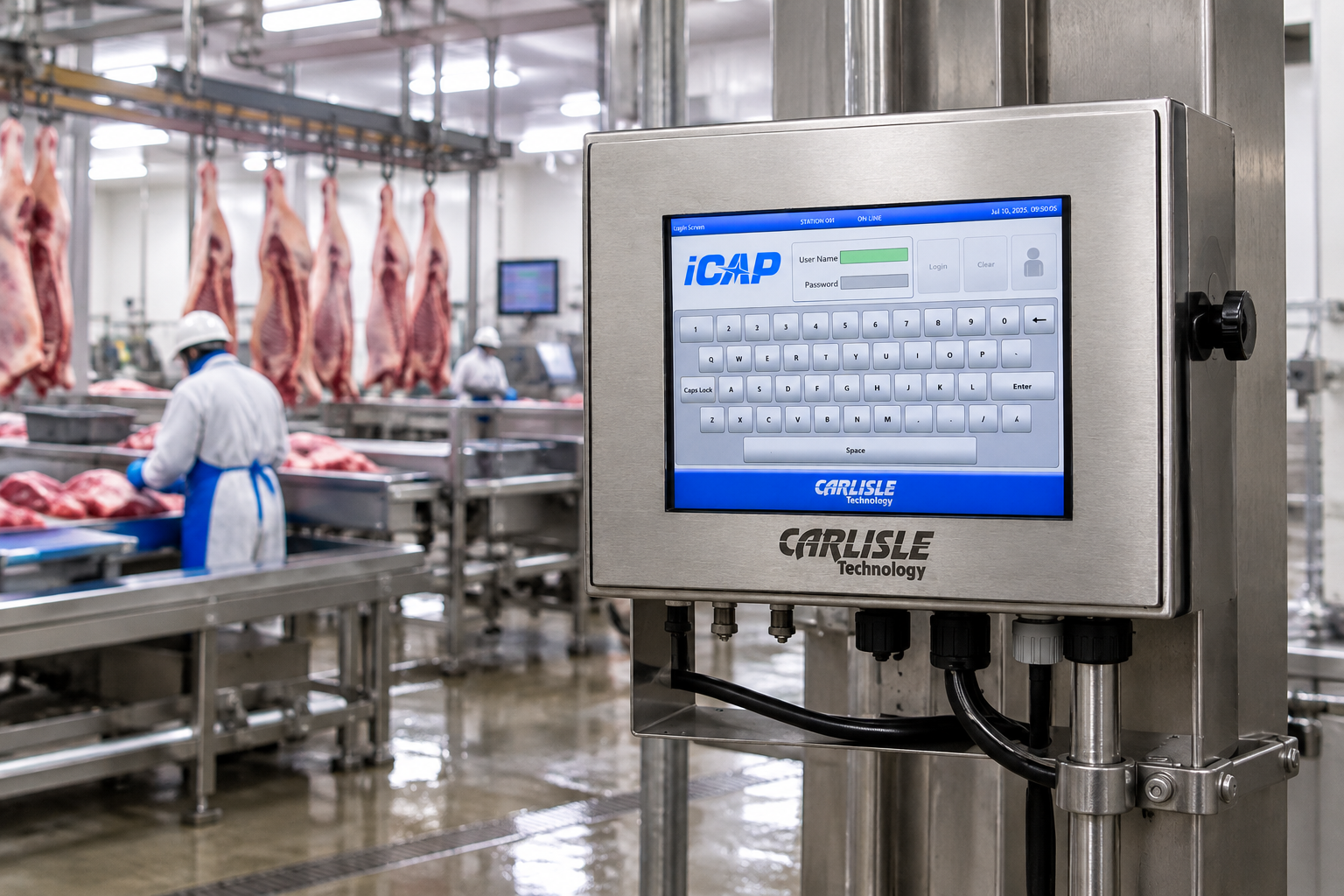
Carlisle Technology has built software and hardware exclusively for meat, poultry, pork, pet food and further processing plants in the U.S. and Canada since 1985. Its Symphony platform is an ERP-agnostic MES and WMS: it runs animal and raw material receiving, kill floor carcass tracking, WIP, catch-weight labeling, inventory and order fulfillment, and integrates with the ERP the processor already runs. iCap is Carlisle's weighing and labeling software, and Carlisle supplies the plant-floor hardware (industrial computers, scales, label printers, print-and-apply systems, mobile computers) so one vendor is accountable from scale to ERP.
Carlisle is a strong fit for mid-size and multi-plant processors who want to keep their ERP, run mixed equipment on the floor, and need native kill-floor or catch-weight functionality. It is a weaker fit for companies that want a single all-in-one ERP covering finance and production in one database.
"Carlisle was able to get us where we wanted handling procurement, warehousing, traceability, and shipping while integrating real time data with our ERP system." — Garrett Rude, Managing Partner, Spectrum Preferred Meats
See how Symphony works with your ERP
Frequently asked questions
Can I add an MES to my existing ERP in a meat plant?
Yes. An MES built for meat processing sits beneath the ERP, handles real-time plant-floor capture and traceability, and posts receipts, production, inventory and shipments back to the ERP. Your finance processes don't change.
What does ERP-agnostic mean for meat processing software?
It means the plant-floor software is not tied to one ERP vendor and can integrate with whichever ERP or accounting system the processor already uses, rather than requiring you to adopt the software vendor's own ERP.
Is an MES cheaper than replacing the ERP?
Usually, because the project does not include financial data migration, enterprise-wide retraining or month-end process changes. Total cost still depends on capture points, hardware and integration scope.
How long does it take to integrate meat processing software with an ERP?
Timeline depends on how many data flows are in scope, the ERP's interface options, and how clean product and customer master data are.
Will my accounting team need to learn a new system?
No. They keep working in the ERP. Data from the floor simply arrives automatically instead of on paper.
Do I need new hardware to modernize the plant floor?
Often some. Existing scales and printers can sometimes be reused if they can communicate with the new software. Washdown-rated computers and mobile scanners are typically added at capture points.
Which is better for a meat plant: a meat ERP or ERP plus MES?
A meat ERP suits companies wanting one database for everything and willing to replace finance systems. ERP plus a meat-specific MES/WMS suits companies whose finance systems work and whose problems are on the plant floor.
Can the plant-floor system keep running if the ERPis down?
A well-designed plant-floor platform keeps weighing, labeling and tracking locally and syncs with the ERP when the connection returns. Confirm this with any vendor you evaluate.
Previous Blog Post
Next Blog Post
Let's talk.
Get in touch with our team to find the right solution for your processing plant.
