Blog
Meat Processing Traceability: How End-to-End Traceability Works From Receiving to Shipping

Short answer: End-to-end traceability in a meat plant means every finished case can be linked, through recorded production batches, to the animals or raw material lots it came from, and forward to every customer who received it. You get there by capturing a unique ID, weight and lot at four points (receiving, production/WIP, finished goods labeling and shipping) and linking each step to the one before it. When those links are captured digitally at the scale and scanner, a full trace takes minutes instead of hours.
What is traceability in meat processing?
Traceability is the ability to follow product one step back and one step forward, plus, inside the plant, every transformation in between. Regulators mostly require the external steps. Customers, auditors and your own recall exposure require the internal ones, because without them a single bad input lot can force you to recall a whole day of production instead of a few pallets.
What data is required for meat traceability?
How does traceability software work in a meat plant?
- Receive: Animals or raw material are weighed and assigned a receiving lot. Animal IDs are scanned or keyed; supplier lots are recorded.
- Track the kill: Each carcass gets an ID (often via RFID, trolley tracking or a data-matrix tag) linked to the animal, with hot weights and grades captured automatically.
- Issue into production: Operators scan carcasses, combos or raw cases into a production batch. The system records which input lots went into which batch.
- Weigh and label outputs: At the scale, the operator selects the product; the system weighs it, prints a GS1-128 label with lot and serial, and links the case to its batch.
- Store and ship: The WMS scans cases and pallets into locations and onto orders, recording exactly which serials or lots went to which customer.
- Trace: A query on any lot, serial, carcass or customer walks the chain backward and forward and produces a report.
The critical step is #3. Many plants record receiving and shipping well but lose the trail in production, so a trace has to assume "everything produced that day" is affected. WIP tracking is what turns a day-sized recall into a batch-sized one.
What role do GS1-128 barcodes play in meat traceability?
GS1-128 is the barcode standard most North American meat customers expect on cases. It encodes multiple data fields using Application Identifiers (AIs), so a single scan captures what used to be read and typed by hand. Common AIs on meat cases include:
Serialized case labels (AI 21) are what allow a WMS to know exactly which cases shipped to which customer, rather than just which lots.
What do USDA and CFIA require?
United States (USDA FSIS): Federally inspected meat and poultry establishments must keep records of their purchases, sales and receipts of product (9 CFR Part 320) and make them available to FSIS. When a recall happens, FSIS expects the establishment to identify affected product and its distribution quickly.
FDA FSMA 204: The FDA Food Traceability Rule requires additional records for foods on the Food Traceability List; its compliance date has moved to July 20, 2028. Meat and poultry under exclusive USDA jurisdiction are generally outside it, but further processors using listed ingredients, and retail and foodservice customers building the rule into supplier requirements, are pushing similar data expectations down the supply chain.
Canada (CFIA): Under the Safe Food for Canadians Regulations, licence holders must keep traceability documents that identify the food and trace it one step back and one step forward, retain them for two years, and be able to provide them to CFIA promptly on request.
Regulations set the floor. Internal genealogy (step #3 above) is what determines how big your recall is.
How do you run a mock recall in a meat processing plant?
- Pick a real lot without warning the team: a raw material lot, a carcass or a finished goods lot.
- Start the clock.
- Trace backward to the supplier or animals and record the source documents.
- Trace internally to every production batch that consumed it.
- Trace forward to every finished lot or case and every customer who received it.
- Reconcile quantities: what came in vs. what was produced vs. what shipped vs. what is still on hand. Unexplained gaps are findings.
- Stop the clock, document time and accuracy, and record corrective actions.
Most GFSI-benchmarked schemes (such as SQF and BRCGS) expect traceability and recall procedures to be tested at least annually, and many customers ask to see results.
How fast should a meat processor be able to trace product?
There is no single legal stopwatch for internal traces, but the practical expectation from auditors and large customers is hours, not days, and digital systems routinely make a full forward-and-backward trace possible in minutes. The more useful targets are: (1) 100% quantity reconciliation, and (2) a recall scope limited to the batches that actually consumed the affected input.
How can digital traceability reduce the size and cost of a recall?
- Smaller scope: batch-level genealogy means you recall the batches that used the bad input, not the whole shift or day.
- Faster notice: shipment-level data identifies customers in minutes, shrinking the window in which affected product is sold.
- Accurate quantities: catch-weight inventory shows exactly what is still in your cooler versus what shipped.
- Credibility with regulators and customers: a clean, fast trace report reduces the likelihood of expanded recall scope.
Manual vs. digital traceability: which is better?
Manual systems can satisfy minimum one-up/one-down rules in small plants. As volumes, SKUs and customers grow, the gap in recall exposure and labor cost widens quickly.
What should you look for in meat traceability software?
- Capture at all four points (receiving, production/WIP, labeling, shipping), not just labeling.
- Native catch weight through every step.
- Kill floor support if you slaughter: animal ID, RFID or trolley tracking, carcass weights and grades.
- GS1-128 and serialized case and pallet labeling.
- One-click forward and backward trace reports by lot, serial, carcass, customer or date range.
- Direct scale, printer and scanner integration on washdown-rated hardware.
- ERP integration so shipment and customer data match your invoices.
- References from processors in your species and size range.
How Carlisle Technology approaches traceability
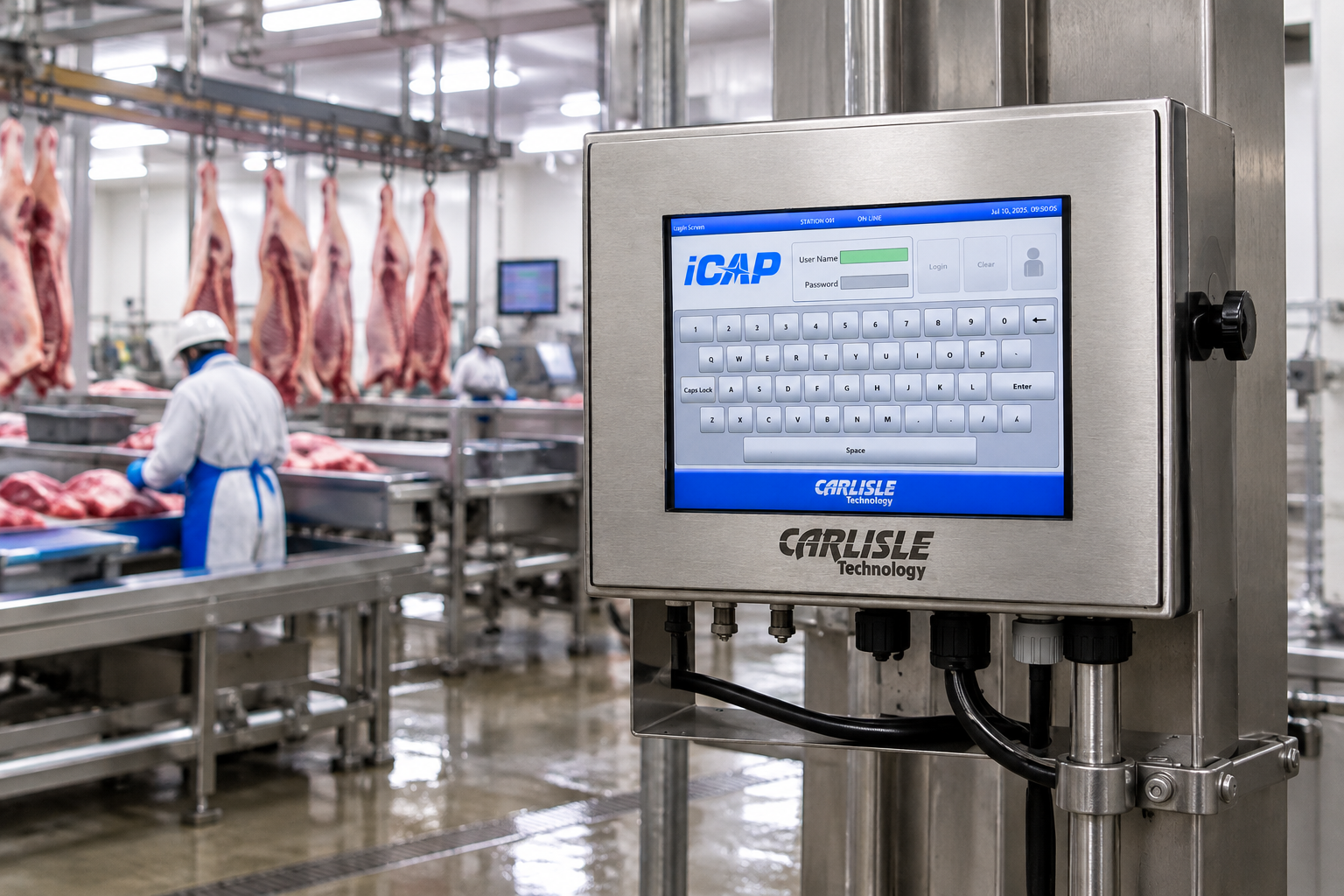
Carlisle Technology, which has served meat processors in the U.S. and Canada since 1985 and published Food Traceability for Dummies, builds traceability into every step of its Symphony MES/WMS rather than as a separate module. Symphony records animal and raw material receiving, carcass data on the kill floor, every input issued into production batches, every output weighed and labeled through iCap, and every case scanned onto a shipment, producing complete backward and forward traces from a single query. It supports GS1-128 barcoding, serialized piece, case and pallet labels, catch weight, and integration with the processor's existing ERP.
Get the free Food Traceability for Dummies book · See a traceability demo
Frequently asked questions
What is one-up, one-down traceability?
It is the requirement to know who you received a product from (one step back) and who you shipped it to (one step forward). It is the regulatory baseline but does not cover what happens inside the plant.
What is lot genealogy in meat processing?
Lot genealogy is the recorded parent-child relationship between input lots (animals, carcasses, raw cases) and the production batches and finished lots made from them.
How does WIP tracking improve traceability?
WIP tracking records which inputs entered each production batch and which outputs came out, so a trace can isolate exactly the affected batches instead of assuming a whole day's production is involved.
How often should a meat plant run a mock recall?
At least annually under most food safety certification schemes, and more often when you change systems, suppliers or products. Many processors test quarterly.
Can traceability work without an ERP?
Yes. Plant-floor traceability can run in a dedicated MES/WMS. Integrating with an ERP mainly ensures shipment and customer records match invoices.
Do small meat processors need traceability software?
Not always on day one. Small plants often start with automated weighing and labeling with lot capture, then add WIP and warehouse tracking as volume grows.
What is the difference between traceability and recall management?
Traceability is the data and links. Recall management is the process of using that data to identify, isolate, notify and retrieve affected product.
Previous Blog Post
Next Blog Post

Let's talk.
Get in touch with our team to find the right solution for your processing plant.
