Blog
US Meat Recalls: What They Reveal About Risk, Readiness, and Traceability for U.S. Processors
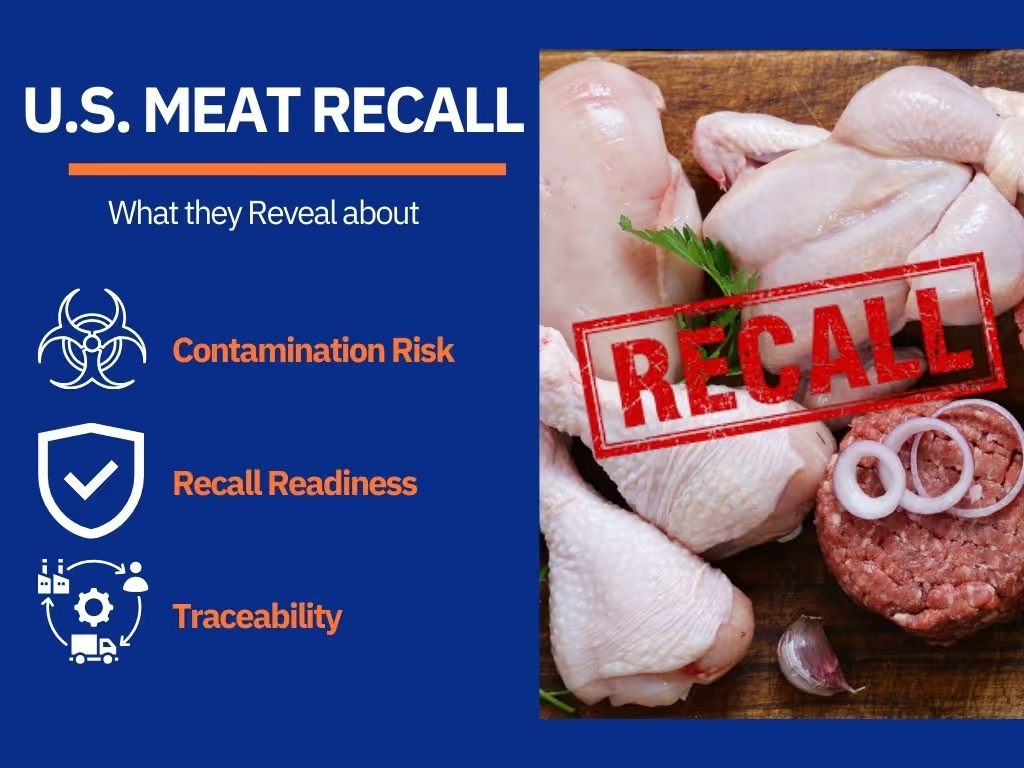
In 2025, recall risk did not just show up in raw product. Some of the most disruptive actions involved ready-to-eat and heat-and-serve items, where complexity is high, changeovers are frequent, and one weak control point, such as metal detection, label verification, supplier ingredient approval, or lot genealogy, can cascade into a brand-level incident.
Below is a processor-focused recap of key 2025 meat and poultry recalls and public health alerts, along with the operational patterns behind them and a practical recall-readiness playbook you can use to pressure-test your plant.
What 2025 recalls had in common
Across the year, the same failure modes showed up again and again:
- Foreign material (metal, plastic, wood): often tied to equipment wear, packaging line issues, or upstream ingredients
- Listeria and pathogen concerns: especially disruptive in ready-to-eat categories
- Misbranding and undeclared allergens: frequently changeover-driven and preventable with stronger label governance
- Inspection and import gaps: compliance breakdowns that create avoidable risk and customer fallout
Key 2025 recalls processors should study
1) Foreign material: small objects, massive consequences
Foreign material issues repeatedly triggered high risk events. Three patterns matter most for plants: equipment condition, end of line detection, and how fast you can scope the exposure window (line, shift, time block, lots).
Notable 2025 examples:
- Hormel Foods Corporation: ready to eat frozen chicken products (possible metal contamination)
https://www.fsis.usda.gov/recalls-alerts/hormel-foods-corporation-recalls-ready-eat-frozen-chicken-products-due-possible - LSI, Inc.: Korean barbecue pork jerky (possible metal contamination)
https://www.fsis.usda.gov/recalls-alerts/lsi-inc--recalls-bbq-pork-jerky-product-due-possible-foreign-matter-contamination - A. Sween Company: pulled pork sandwich product (possible plastic contamination)
https://www.fsis.usda.gov/recalls-alerts/e-a--sween-company-recalls-pulled-pork-sandwich-products-due-possible-foreign-matter - Olympia Provisions: ready to eat holiday kielbasa sausage (possible metal contamination)
https://www.fsis.usda.gov/recalls-alerts/olympia-provisions-recalls-ready-eat-holiday-kielbasa-sausage-products-due-possible
What this means operationally:
Foreign material prevention is not just metal detection at the end. It is a lifecycle control: preventive maintenance plus line checks plus verification records tied to lots. When something is found, speed depends on whether you can isolate exactly which production windows share the same exposure.
2) Pathogens and ready to eat risk: traceability is time
When Listeria or other pathogen risks are involved, response windows shrink. The processors that move fastest are the ones who can rapidly answer: what lots are impacted, what went where, and what else is exposed through shared equipment, rework, or ingredients.
Notable 2025 examples:
- Kraft Heinz Foods Company: turkey bacon (possible Listeria monocytogenes)
https://www.fsis.usda.gov/recalls-alerts/kraft-heinz-foods-company-recalls-turkey-bacon-products-due-possible-listeria - Mountain West Food Group, LLC: raw ground beef (possible E. coli O26)
https://www.fsis.usda.gov/recalls-alerts/mountain-west-food-group-llc-recalls-ground-beef-products-due-possible-e--coli-o26
What this means operationally:
If you cannot instantly answer what lots shipped where, you lose hours or days to spreadsheets, emails, and phone calls, exactly when customers and regulators expect decisive containment.
3) Misbranding and undeclared allergens: the paperwork recall that shuts down production
These events can be especially painful because the product may be safe in every other way, until labeling or allergen disclosure turns it into a high risk compliance issue.
Notable 2025 examples:
- Hearthside Food Solutions, LLC: ready to eat sausage and bacon breakfast sandwiches (misbranding and undeclared allergen)
https://www.fsis.usda.gov/recalls-alerts/hearthside-food-solutions-llc-recalls-ready-eat-sausage-and-bacon-breakfast - Suzanna’s Kitchen: fully cooked breaded chicken products (misbranding and undeclared allergen)
https://www.fsis.usda.gov/recalls-alerts/suzannas-kitchen-recalls-fully-cooked-breaded-chicken-products-due-misbranding-and
What this means operationally:
Allergen and label events are often governance failures: who can change labels, how approvals are logged, how label versions are tied to specific runs, and how line side verification is enforced during changeovers.
4) Inspection and import controls: compliance gaps become customer risk
Even if your plant runs tight, supplier, import, or inspection handling gaps can create avoidable exposure and downstream customer issues.
Notable 2025 examples:
- Maître Saladier Inc.: Lorraine quiche with pork (imported without benefit of import reinspection)
https://www.fsis.usda.gov/recalls-alerts/maitre-saladier-inc--recalls-lorraine-quiche-products-imported-without-benefit - Ghanaianway Restaurant and Grocery LLC: salted lamb (produced without the benefit of inspection)
https://www.fsis.usda.gov/recalls-alerts/ghanaianway-restaurant-and-grocery-llc-recalls-fresh-salted-lamb-products-produced
What this means operationally:
Treat inspection and import documentation as part of end to end traceability, not a separate compliance silo. When documentation and receiving controls are inconsistent, the paper gap becomes a product risk.
The real cost is not just product, it is time, proof, and trust
Most mid to large processors can pull product. The differentiator is whether you can:
- Scope the incident precisely (avoid over recall)
- Prove control quickly (to customers, regulators, and internal leadership)
- Communicate confidently across distribution channels
- Resume normal operations without chaos
That all depends on one capability: lot level genealogy you trust from receiving to WIP to packaging to shipping.
The 30 minute recall readiness test (run this in your next mock recall)
Pick a real SKU and date range. Then challenge your team.
Can you answer these in 30 minutes?
- Lot genealogy: Which raw and WIP lots fed this finished lot (including rework and repack)?
- Production context: Which line, shift, and equipment ran it?
- Label versioning: Which label revision was applied and who approved it?
- Ship to truth: Which customers and DCs received it, and in what quantities?
- Blast radius: What else ran before or after on shared equipment, and what lots are potentially exposed?
If any of these require going through spreadsheets, paper travelers, or email threads, you have found the next high impact improvement project.
Recall readiness checklist (copy and paste into your SOP)
Prevention controls
- Preventive maintenance and inspection logs tied to equipment ID plus line plus production windows
- Foreign material program with detection validation and trend reviews (not just pass or fail)
- Label governance with approval workflow and version control
- Changeover verification (formula, allergens, label, case code) with line side enforcement
Response controls
- Mock recalls quarterly, rotating SKUs and scenarios
- Clear stop ship and hold workflows tied to specific lots (not generic SKUs)
- A single source of truth for lots, inventory status, and shipments
- Pre built customer contact lists and response templates for rapid execution
Where systems like Symphony help plants reduce recall scope and response time
For mid to large meat processors, recall readiness is an outcome of a connected execution and traceability environment. Plants improve speed and reduce disruption when they can reliably manage:
- Lot level traceability across raw, WIP, finished goods, rework, and repack
- Real time WIP and inventory visibility so you can stop the right product, not everything
- Labeling and case code consistency tied to production orders and controlled revisions
- Recall execution supported by structured, searchable shipment and customer data
Learn more about Symphony for meat processors:
Source links (FSIS recall notices referenced)
- Hormel frozen chicken (foreign material):
https://www.fsis.usda.gov/recalls-alerts/hormel-foods-corporation-recalls-ready-eat-frozen-chicken-products-due-possible - LSI pork jerky (foreign material):
https://www.fsis.usda.gov/recalls-alerts/lsi-inc--recalls-bbq-pork-jerky-product-due-possible-foreign-matter-contamination - Kraft Heinz turkey bacon (Listeria):
https://www.fsis.usda.gov/recalls-alerts/kraft-heinz-foods-company-recalls-turkey-bacon-products-due-possible-listeria - Hearthside breakfast sandwiches (undeclared allergen):
https://www.fsis.usda.gov/recalls-alerts/hearthside-food-solutions-llc-recalls-ready-eat-sausage-and-bacon-breakfast - Mountain West ground beef (E. coli O26):
https://www.fsis.usda.gov/recalls-alerts/mountain-west-food-group-llc-recalls-ground-beef-products-due-possible-e--coli-o26 - A. Sween pulled pork sandwiches (foreign material):
https://www.fsis.usda.gov/recalls-alerts/e-a--sween-company-recalls-pulled-pork-sandwich-products-due-possible-foreign-matter - Suzanna’s Kitchen breaded chicken (undeclared allergen):
https://www.fsis.usda.gov/recalls-alerts/suzannas-kitchen-recalls-fully-cooked-breaded-chicken-products-due-misbranding-and - Olympia Provisions kielbasa (foreign material):
https://www.fsis.usda.gov/recalls-alerts/olympia-provisions-recalls-ready-eat-holiday-kielbasa-sausage-products-due-possible - Maître Saladier quiche (import reinspection):
https://www.fsis.usda.gov/recalls-alerts/maitre-saladier-inc--recalls-lorraine-quiche-products-imported-without-benefit - Ghanaianway salted lamb (produced without inspection):
https://www.fsis.usda.gov/recalls-alerts/ghanaianway-restaurant-and-grocery-llc-recalls-fresh-salted-lamb-products-produced
Sign Up for Our Newsletter!
Receive updates on products, customer stories, and giveaways!
[ctct form="21261" show_title="false"]
Previous Blog Post
Next Blog Post
.jpg)
.jpg)
Let's talk.
Get in touch with our team to find the right solution for your processing plant.